
Floor plan marketing in real estate is the strategic deployment of scaled, dimensioned 2D and 3D property layout drawings across all listing channels – MLS submissions, property portals, social media, email campaigns, and printed collateral – to accelerate buyer decision velocity, reduce unqualified viewings, and shorten days on market. According to the National Association of Realtors’ 2024 Generational Trends Report, floor plans rank as the third most important feature buyers expect on a real estate listing, behind only photographs and detailed property descriptions. Top-performing agents who embed professional floor plan assets into every stage of their listing presentation, marketing funnel, and seller pitch systematically outperform the competition on days on market, enquiry volume, and commission-earning listings won per quarter.
The data is stark. Rightmove’s portal analytics show that listings including a floor plan receive 52% more clicks than those without. Zillow reports that listings featuring interactive floor plans generate 72% more shares, 60% more views, and are saved 79% more often by prospective buyers. Yet research from Homediary’s 2025 Marketing Report found that while over 80% of buyers consider a floor plan important, fewer than 20% of active listings actually include one. That gap is the competitive opportunity. And the agents who close it, consistently, are the agents who win their local markets.
If you are serious about turning your listing presentations into closings, commissioning professional 2D and 3D floor plan production and architectural visualization services is one of the highest-leverage investments an agent or brokerage can make.

Why Floor Plan Marketing Real Estate Strategy Starts Before the Listing Goes Live
Most agents treat the floor plan as an afterthought – something added to a live listing after photos have been uploaded. Top agents treat it differently. They commission the floor plan during the listing preparation phase and use it as a strategic tool long before the property ever hits the portal.
Here is why the sequence matters:
- Listing presentation differentiation: Presenting a seller with a sample professional floor plan during the listing pitch – alongside your marketing plan – immediately positions you above every competing agent who arrives with a CMA and a phone camera.
- Pre-launch social media content: A clean, visually polished floor plan posted as a “coming soon” teaser generates buyer interest before the live date, pre-qualifying the audience before the first showing.
- Agent co-operation packages: When you send a floor plan to buyer’s agents alongside the listing brief, you reduce friction for buyers in the research phase and attract higher-quality, better-qualified showing requests.
- Pricing strategy support: For complex properties – split-level homes, properties with converted outbuildings, or apartment buildings – a dimensioned floor plan makes the price-per-square-foot calculation transparent and defensible.
The agents who understand this sequence use floor plan marketing not just as a listing asset, but as a client acquisition tool, a competitive differentiator, and a trust-building mechanism with sellers.
The Data Behind Floor Plan Marketing in Real Estate: Why It Works
Before exploring the specific strategies, it is worth grounding the conversation in measurable performance data. These are not projections; they are documented outcomes from major property portals and research institutions.
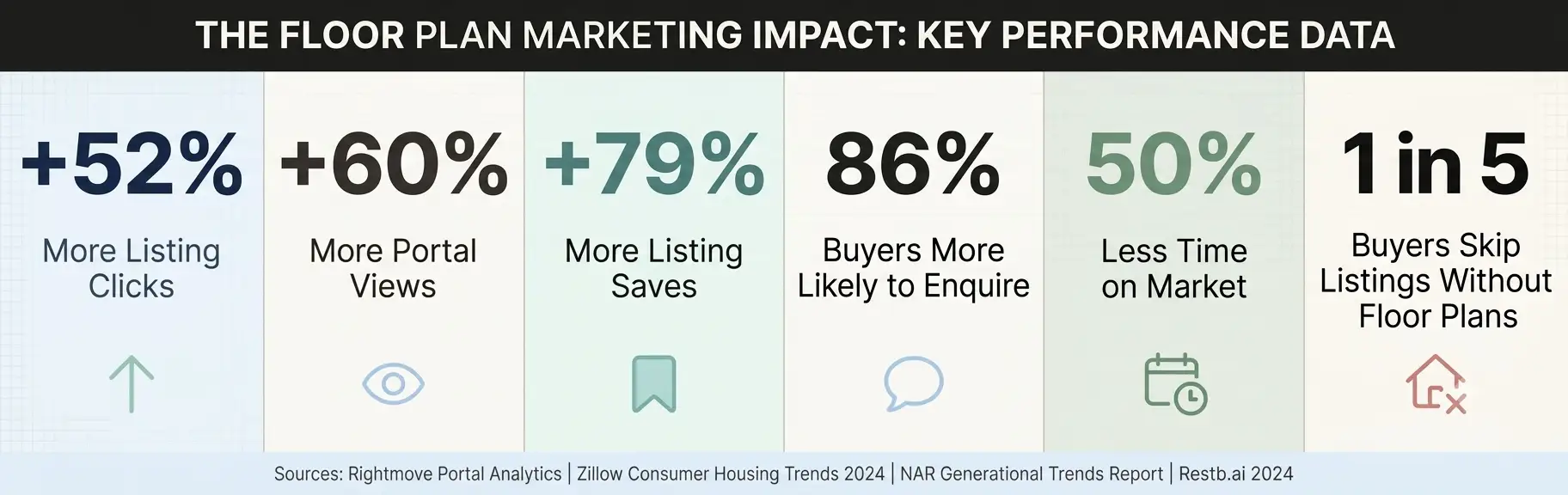
| Performance Metric | Without Floor Plan | With Floor Plan | Source |
|---|---|---|---|
| Listing click-through rate | Baseline | +52% more clicks | Rightmove portal data |
| Listing views | Baseline | +60% more views | Zillow Interactive Floor Plans |
| Social shares per listing | Baseline | +72% more shares | Zillow Interactive Floor Plans |
| Saves and watchlist additions | Baseline | +79% more saves | Zillow Interactive Floor Plans |
| Days on market (Chicago study) | 11.3 days avg | 8.5 days avg | Restb.ai, 2024 |
| Buyer skip rate (no floor plan) | 20% will skip listing | – | NAR 2024 Consumer Report |
| Buyer engagement (floor plan present) | – | 86% more likely to enquire | Zillow 2024 Consumer Housing Trends |
| Time on market reduction | Baseline | Up to 50% less time | Homes for Heroes, 2024 |
This data tells a consistent story: floor plan marketing in real estate is not a premium add-on for luxury listings. It is a baseline performance driver for any agent who wants their listings to perform in a competitive, digitally-native market.
As Matterport’s real estate marketing research notes, prospective buyers can extract a wealth of information from a single glance at a floor plan – from total square footage to spatial flow – information that photographs simply cannot deliver.
7 Proven Ways Top Real Estate Agents Use Floor Plans to Win Their Market
1. Including Floor Plans in Every Listing – Without Exception
The first and most fundamental strategy is deceptively simple: never publish a listing without a professional floor plan. Not for entry-level properties, not for rentals, and certainly not for premium listings.
The rationale goes beyond engagement statistics. A listing without a floor plan signals to buyers that either the agent does not take marketing seriously, or the layout is something the seller wants to hide. Neither impression helps.
Top agents make the floor plan a non-negotiable deliverable in their standard listing package. They build the cost into their commission structure or absorb it as a business development expense – because the return on a professional floor plan, measured in enquiries, viewings, and faster sales, consistently exceeds its production cost.
Our resource on how 3D floor plans help real estate agents sell properties faster explores the specific mechanisms behind this performance in detail.
2. Choosing the Right Floor Plan Format for the Property Type
Not every listing benefits from the same floor plan format. Top agents understand the distinction between 2D and 3D floor plan formats and deploy each strategically based on the property, the target buyer, and the marketing channel.
Here is how the most effective agents approach format selection:
2D Floor Plans work best for:
- Buyers and investors who are experienced with architectural drawings
- MLS submissions and portal listings where file size matters
- Printed property brochures and agent marketing packs
- Complex multi-level commercial or apartment properties where spatial clarity is the priority
3D Floor Plans work best for:
- Off-the-plan and new construction marketing where buyers cannot visit
- Residential listings targeting first-time buyers who struggle to interpret flat line drawings
- Premium and luxury properties where visual impact is part of the brand
- Social media content where visual appeal drives engagement and shares
- Properties with strong spatial flow or open-plan layouts that deserve to be “felt”
According to research by Coohom, buyers understand spatial flow up to 60% faster when presented with a 3D floor plan rather than a traditional 2D drawing. For buyers making one of the largest financial decisions of their lives, reducing cognitive friction at the research stage has a direct and measurable impact on enquiry and conversion rates.
The decision framework for choosing between formats is covered in depth in our comparison of 2D floor plans versus 3D floor plans – a useful reference point for any agent building a tiered listing package.
3. Using Floor Plans as the Centrepiece of Listing Presentations
Winning the listing is the first revenue event in the agent’s pipeline. The listing presentation is the sales process that determines whether you win it or lose it to a competitor.
Top agents in competitive markets now include floor plan samples – both 2D and 3D – in every listing presentation they deliver. Here is how they use them:
During the seller meeting:
- Show sample floor plans from comparable properties you have sold
- Explain how the floor plan reduces unqualified viewings (a tangible benefit sellers care about)
- Present the floor plan as part of a multi-channel marketing schedule, not an isolated asset
- Use the floor plan conversation to position yourself as a marketing-focused professional rather than just a transaction agent
As a leave-behind:
- Provide a printed sample marketing package that includes a floor plan alongside photos, a virtual tour link, and the social media content calendar
- The visual quality of your sample floor plan signals the quality of your overall service
As a differentiator:
- In markets where most agents arrive with a CMA and generic talking points, a physical floor plan sample immediately creates a tangible, memorable difference
- Sellers who have received poor marketing on previous sales are particularly responsive to agents who demonstrate a structured, professional visual marketing approach
4. Building a Floor Plan-Led Social Media Content Strategy
Social media is where floor plan marketing real estate strategy has the most underutilised upside. Most agents post photos and occasionally a virtual tour. Very few build a floor plan-led content series.
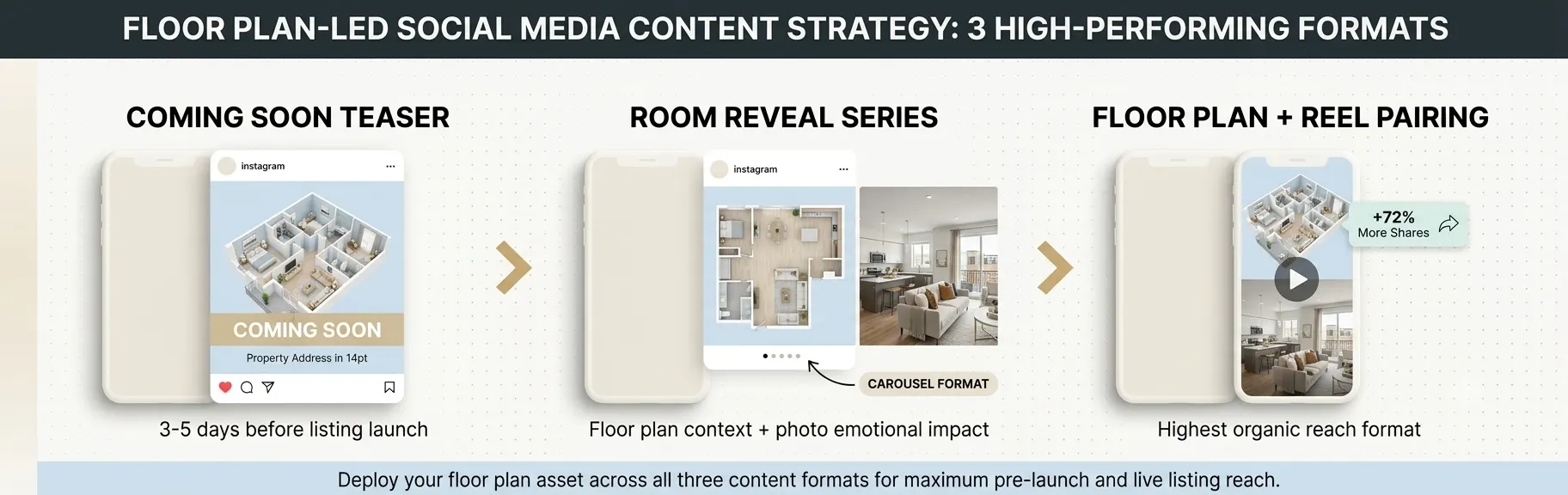
Here is the content strategy top agents in premium markets are implementing:
Coming Soon Teaser Posts: Post the floor plan – styled with brand colours, the property address, and a “Coming Soon” overlay – 3 to 5 days before the listing goes live. This pre-conditions the market, generates saves and shares, and ensures a warm audience is ready on launch day.
Room-by-Room Breakdown Series: Pair a cropped detail of the floor plan (highlighting one specific room) with a corresponding photo of that room. “Here is how the open-plan kitchen, dining, and living zone flows” – with the floor plan detail showing the spatial relationship – generates significantly more engagement than a standalone photo.
Floorplan + Feature Video Pairing: A short 15-30 second Reel or TikTok that transitions from the floor plan to a walkthrough video of the same space is one of the highest-performing real estate content formats available. The floor plan provides context; the video delivers emotional impact.
Comparison Content: “Here are three properties at the same price point in [suburb] – here is how their layouts compare.” Floor plan comparison content positions you as a local market expert and drives follower growth because buyers in your target area bookmark it as a reference resource.
Sociallyin’s 2026 social media research found that market-leading agents consistently generate 2 to 3 times more qualified leads through strategic social media content compared to traditional outreach. Floor plans are the content asset that most consistently drives that result.
5. Embedding Floor Plans Into Email and CRM Marketing Campaigns
Email remains the highest ROI marketing channel in real estate when used correctly. Most agents send photo-heavy email blasts. Top agents embed the floor plan as the lead visual asset.
The logic is straightforward: a photo shows one angle of one room at one moment. A floor plan shows every room, every connection, every dimension, and total square footage – in a single image that takes a buyer five seconds to absorb.
High-performing email formats that use floor plans:
- New listing announcement: Floor plan as the hero image above the fold, with a brief property summary and a single CTA button
- Price reduction update: “Here is what changed – and here is the full layout for $X less” – the floor plan reinforces value
- Weekly market round-up: Three local listings side by side, each represented by its floor plan thumbnail, with brief stats
- Seller update email: Send your vendor a screenshot of the listing analytics (views, clicks) alongside the floor plan image to demonstrate that your marketing package is performing
Agents who use floor plans in email campaigns consistently report that their listing emails outperform photo-only emails in click-through rate, because the floor plan image is cognitively distinctive – it looks different from every other listing email the buyer receives.
6. Using 3D Floor Plans and Exterior Renders to Sell Off-the-Plan and Pre-Construction
For agents working in new development, pre-construction, or off-the-plan sales – where buyers cannot physically visit a finished product – floor plan marketing in real estate takes on an entirely different level of importance.
In this context, the floor plan is not a supplement to the physical property experience. It is the entire product experience.
The off-the-plan marketing toolkit that top agents deploy:
- A professional 2D dimensioned floor plan for each unit type or home design
- A 3D floor plan showing the same unit with furniture, materials, and spatial depth
- A photorealistic 3D exterior rendering showing how the building or home will look on completion
- A 3D aerial rendering for larger multi-lot or apartment complex developments
Each layer adds a dimension of certainty for the buyer, reducing the anxiety of purchasing something that does not yet exist.
Our 3D exterior rendering services are specifically designed for this workflow – and our 3D aerial rendering pricing guide gives developers and agents a clear cost framework for budgeting the full visualization package.
Buyers who can clearly see and understand the layout, scale, and appearance of a property before it is built make faster decisions, place fewer contingent offers, and are significantly less likely to pull out of contracts during the due diligence phase.
7. Packaging Floor Plans for Seller Reporting and Retention
One of the least-discussed applications of floor plan marketing in real estate is its role in managing the seller relationship after a listing goes live. Top agents use the floor plan not just to attract buyers but to demonstrate their marketing professionalism to their vendor throughout the campaign.
Practical seller retention applications:
- Weekly vendor report: Include a screenshot of portal analytics alongside the floor plan image to show the listing is performing as a cohesive, professional package
- Post-inspection feedback sessions: Reference the floor plan when relaying buyer feedback about layout preferences, flow, or room sizing – it makes the conversation more precise and credible
- Price renegotiation discussions: When a price adjustment becomes necessary, using the floor plan to compare the property’s layout against competing listings at the adjusted price range makes the recommendation more persuasive and less personal
- Re-listing refresh: When a listing has been on market for an extended period, upgrading from a 2D floor plan to a 3D floor plan is a cost-effective refresh strategy that demonstrably changes the listing’s visual presentation and buyer engagement
Floor Plan Marketing Real Estate: 2D vs. 3D vs. Interactive – Which Format Wins?
The format decision shapes the effectiveness of every other strategy. Here is a precise breakdown of the three primary formats and their optimal use cases:
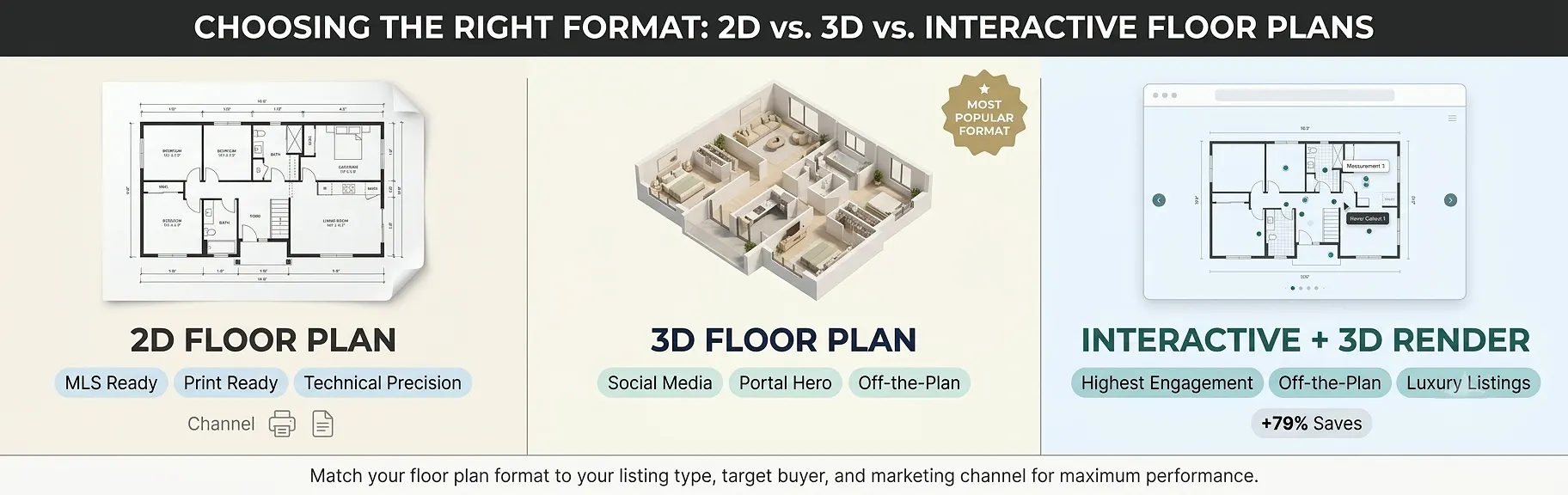
| Format | Visual Depth | Best Channel | Typical Buyer Response | Relative Cost |
|---|---|---|---|---|
| 2D Black and White | Flat, technical | MLS, permit docs | Functional; suits experienced buyers | Lowest |
| 2D Coloured | Flat with room fills | Portal listings, print brochures | Clearer room differentiation; more buyer-friendly | Low-Medium |
| 3D Floor Plan | Perspective view with furniture | Portals, social media, email | High visual engagement; suits all buyer types | Medium |
| Interactive Floor Plan | Clickable, measurable rooms | Portals with interactive features, microsites | Highest engagement; buyers spend 3x longer | Medium-High |
| 3D Floor Plan + Exterior Render | Full property visualization | Off-the-plan, luxury, new build | Emotional connection; fastest decision velocity | High |
For most residential listings in competitive markets, the 3D floor plan format delivers the strongest balance between visual impact and production cost. For off-the-plan, luxury, and new construction listings, combining a 3D floor plan with a photorealistic exterior rendering produces the most complete buyer experience possible before a physical inspection.
How to Turn a Rough Sketch or Site Measurement Into a Professional Floor Plan
Many agents have a hand-drawn sketch, a rough site measurement, or even a photograph of an existing plan on the wall during their listing appraisal. That is sufficient to commission a professional floor plan. Here is the standard production workflow:
- Capture the source material: Take clear photos of any existing plans, rough sketches, or hand-drawn measurements during the property appraisal.
- Submit to a professional floor plan service: Share the source files along with any known room dimensions, ceiling heights, and preferred presentation style (2D, 3D, coloured, branded).
- Review the draft output: A professional service will return a scaled, accurate draft within 24 to 48 hours for a standard residential property.
- Request revisions if needed: Adjust room labels, dimension placements, or styling to match your brand or the property’s presentation requirements.
- Receive final files: The completed floor plan is delivered in web-resolution and print-resolution formats, ready for portal upload, email, print, and social media.
- Deploy across all channels: Upload to the MLS, portal listing, email campaign, and social content calendar simultaneously on listing day.
The conversion process from a rough sketch to a publication-ready professional drawing is faster and more accessible than most agents realize. Our sketch to professional floor plan conversion service is specifically designed for exactly this workflow.
Common Mistakes Real Estate Agents Make With Floor Plan Marketing
Understanding where floor plan marketing fails helps you avoid the errors that limit its impact.
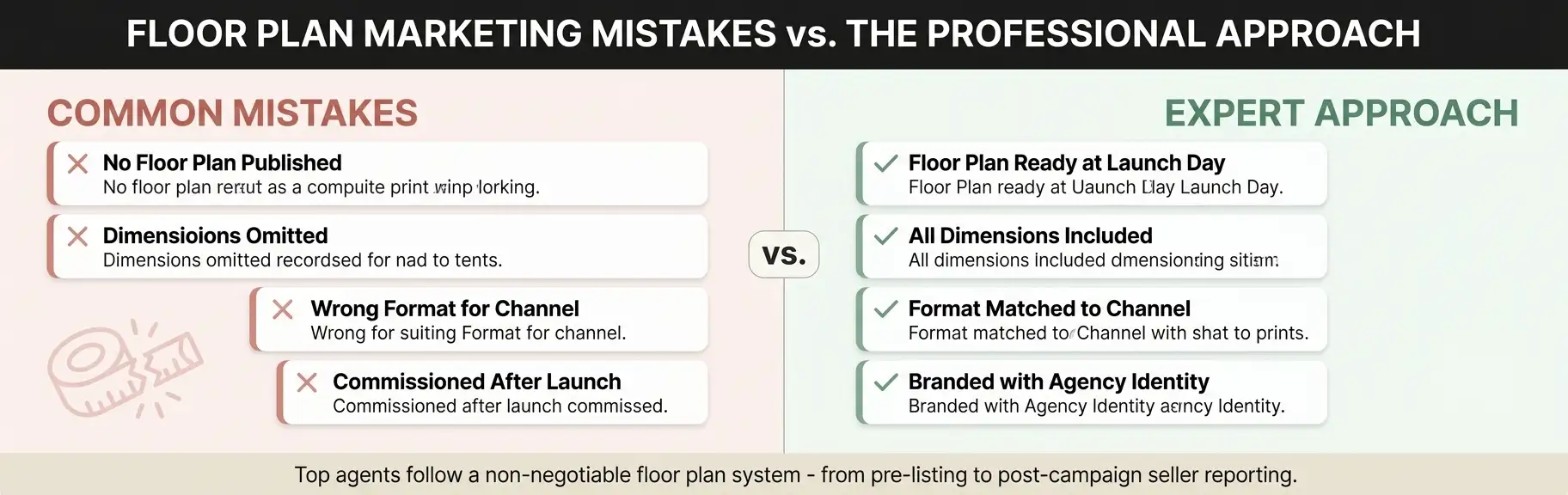
Mistake 1: Using Low-Quality or Inaccurate Floor Plans
A floor plan that contains obvious scaling errors, missing rooms, or unlabelled spaces damages credibility rather than building it. Buyers who notice an inaccuracy in the floor plan immediately question the accuracy of the entire listing. Always commission floor plans from a professional service that delivers dimensionally accurate, scaled drawings.
Mistake 2: Publishing the Floor Plan Without Dimensions
A floor plan without room dimensions forces buyers to estimate. Estimation creates doubt. Doubt delays decisions. Always include key room dimensions – particularly bedroom, living area, and kitchen sizes – on any floor plan used in public marketing.
Mistake 3: Treating the Floor Plan as a Static Document
Most agents upload the floor plan to the portal and never use it again. Top agents use the same floor plan asset across emails, social posts, printed brochures, open home handouts, and seller update reports. One professional asset, deployed across ten touchpoints, multiplies its value exponentially.
Mistake 4: Using the Wrong Format for the Channel
A detailed, dimension-heavy 2D CAD drawing makes a poor Instagram post. A highly stylized 3D render without dimensions makes a poor MLS attachment. Match the floor plan format to the channel it will appear in: technical 2D for MLS and compliance purposes, visually polished 3D for social media and portal hero images.
Mistake 5: Neglecting the Exterior Visualization
Floor plans show internal layout, but buyers also form strong emotional responses to exterior appearance. Pairing a 3D floor plan with a photorealistic 3D exterior rendering delivers a complete property experience – internal logic and external emotion – that significantly outperforms floor plan alone for off-the-plan and new construction marketing.
Mistake 6: Waiting Until After Launch to Commission the Floor Plan
Commissioning the floor plan after the listing goes live means missing the pre-launch marketing window entirely. The “coming soon” social content phase, the buyer’s agent preview email, and the first 48 hours of live portal exposure – the most critical engagement window for any listing – all require the floor plan to be ready on day one.
Mistake 7: Not Branding the Floor Plan
An unbranded floor plan is a missed marketing opportunity. Adding your agency logo, brand colours, contact details, and website URL to the floor plan turns every share, download, and print of that document into a brand impression for your business.
Expert Tips: How to Build a Floor Plan Marketing System as a Real Estate Agent
These practical recommendations come directly from how high-volume agents integrate floor plan marketing into their operational workflow.
Tip 1: Build Floor Plan Production Into Your Listing Preparation Checklist Treat the floor plan order as a mandatory step in your pre-listing checklist, alongside photography and copywriting. Set a standard lead time of 48 hours so it is always ready before launch day.
Tip 2: Create a Branded Floor Plan Template Work with your floor plan service provider to establish a standard branded template that includes your agency logo, contact details, and consistent colour palette. Apply this template to every listing so your floor plans are immediately recognizable as your brand asset in the market.
Tip 3: Segment Your Floor Plan Format by Listing Tier Define a clear tiered system: 2D coloured plans for standard listings, 3D floor plans for premium listings, and 3D floor plan plus exterior render for luxury and new construction. This creates a structured upsell conversation with vendors and ensures you match production cost to listing value.
Tip 4: Use the Floor Plan in Listing Feedback Conversations When relaying buyer feedback to your vendor, reference the floor plan during the conversation. “Buyers in this price bracket are specifically looking for a study or fourth bedroom – here on the floor plan we can see the configuration that may be influencing that feedback” is a more credible and professional conversation than vague impressions.
Tip 5: Track Floor Plan Engagement Metrics On portals that provide asset-level analytics, track how many buyers click on the floor plan versus photos versus the description. Use this data to inform your listing presentation: showing sellers concrete floor plan engagement data from a comparable recent listing is a powerful proof point.
Tip 6: Offer Floor Plans as a Value-Add in Your Seller Pitch Rather than including the floor plan cost in your commission discussion, present it as a named deliverable in your marketing schedule with an explicit value attached. “Our standard marketing package includes a professional 3D floor plan, valued at $X, commissioned at no additional cost to you” positions it as a benefit, not a line item.
Floor Plan Marketing Real Estate: Choosing the Right Service Provider
Not all floor plan services deliver the same quality, turnaround time, or format flexibility. Here is what to evaluate when choosing a production partner:
| Evaluation Criterion | What to Look For |
|---|---|
| Accuracy | Dimensionally correct, scaled drawings with labeled rooms |
| Format options | 2D black/white, 2D coloured, 3D floor plan, exterior render, site plan |
| Turnaround time | 24-48 hours for standard residential; 72 hours for complex or 3D |
| Revision policy | At least one round of revisions included in standard pricing |
| Brand customization | Logo, colour scheme, and contact detail application |
| File delivery formats | High-resolution PNG/JPG for web, PDF for print, DWG for technical use |
| Experience with source materials | Ability to work from rough sketches, photos, or existing plans |
| Portfolio breadth | Residential, commercial, apartment, luxury, new build examples |
A professional floor plan company that handles the full spectrum – from 2D dimensioned drawings to photorealistic 3D renders and exterior visualizations – allows you to operate from a single vendor relationship rather than managing multiple suppliers across different listing types
Frequently Asked Questions
What is floor plan marketing in real estate?
Floor plan marketing in real estate is the practice of including professionally produced, scaled property layout drawings – in 2D, 3D, or interactive formats – across all listing channels, including property portals, MLS submissions, email campaigns, social media, and printed collateral. The goal is to help buyers understand a property’s spatial layout before a physical inspection, reducing unqualified viewings and accelerating buyer decision-making.
Do floor plans really help sell properties faster?
Yes, consistently and measurably. Research data shows that listings with professional floor plans spend up to 50% less time on the market. Rightmove portal data shows listings with floor plans receive 52% more clicks. A 2024 study by Restb.ai across multiple US markets found a direct reduction in days on market for listings that included floor plans, with Chicago showing an average reduction from 11.3 days to 8.5 days.
Should I use a 2D or 3D floor plan for real estate marketing?
It depends on the property type, the target buyer, and the marketing channel. A 2D coloured floor plan is the standard minimum for portal listings and MLS submissions. A 3D floor plan is more effective for social media content, premium residential properties, and off-the-plan developments because it communicates spatial flow and room character to buyers who are not experienced at reading technical architectural drawings. Many top agents use both: 2D for technical documents and MLS, 3D for marketing and social media.
How much does a professional real estate floor plan cost?
Production costs vary based on the property size, the format required (2D vs. 3D), and the level of detail requested. For a standard residential floor plan, professional 2D production typically starts at a very accessible price point that most agents absorb as a standard listing cost. 3D floor plans carry a higher production investment but generate demonstrably higher engagement. Our floor plan and 3D rendering pricing page provides transparent cost information across all service tiers.
Can I commission a floor plan from just a photo or rough sketch?
Yes. Most professional floor plan services can produce accurate, scaled floor plans from photographs of existing drawings, hand-measured sketches, or even clear smartphone photos of the property itself. The key requirement is that the source material contains enough dimensional information for the drafter to produce an accurate scaled drawing. The more precise your measurements, the more accurate the resulting floor plan.
At what stage in the listing process should I commission the floor plan?
Commission the floor plan at the same time you book the property photographer – during the listing preparation phase, before the property goes live. Having the floor plan ready on launch day allows you to use it in pre-launch social media content, in buyer’s agent preview emails, and as the hero asset on the live portal listing from the first hour of publication.
How do floor plans help with social media marketing for real estate?
Floor plans are highly versatile social media content assets. They can be used as “coming soon” teaser posts, as educational content explaining how spaces connect, as paired content with room photos in a “layout reveal” series, and as part of Reel or short-form video content that transitions from the plan to the physical space. According to Zillow’s data, listings with interactive floor plan features are shared 72% more than those without – social sharing behavior that translates directly into organic reach.
What is the difference between a 2D floor plan and a 3D floor plan for real estate?
A 2D floor plan is a flat, top-down scaled drawing showing room outlines, wall positions, door swings, window locations, and dimensions. It communicates layout clearly but requires some spatial literacy to interpret. A 3D floor plan shows the same layout in a perspective or isometric view, with furniture, materials, and visual depth included, making it immediately interpretable by any buyer regardless of their architectural drawing experience. Both formats serve important roles in a comprehensive floor plan marketing real estate strategy.
Floor Plan Marketing Real Estate – The Strategy That Compounds
Floor plan marketing in real estate is not a single tactic. It is a compounding system. Every listing that features a professional floor plan performs better in search, generates more enquiries, attracts more qualified buyers, and reduces the wasted effort of unqualified viewings. Every seller who sees your floor plan during the listing presentation is more likely to sign with you. Every social post that features a floor plan reaches further, earns more shares, and builds more market authority than a photo-only post ever will.
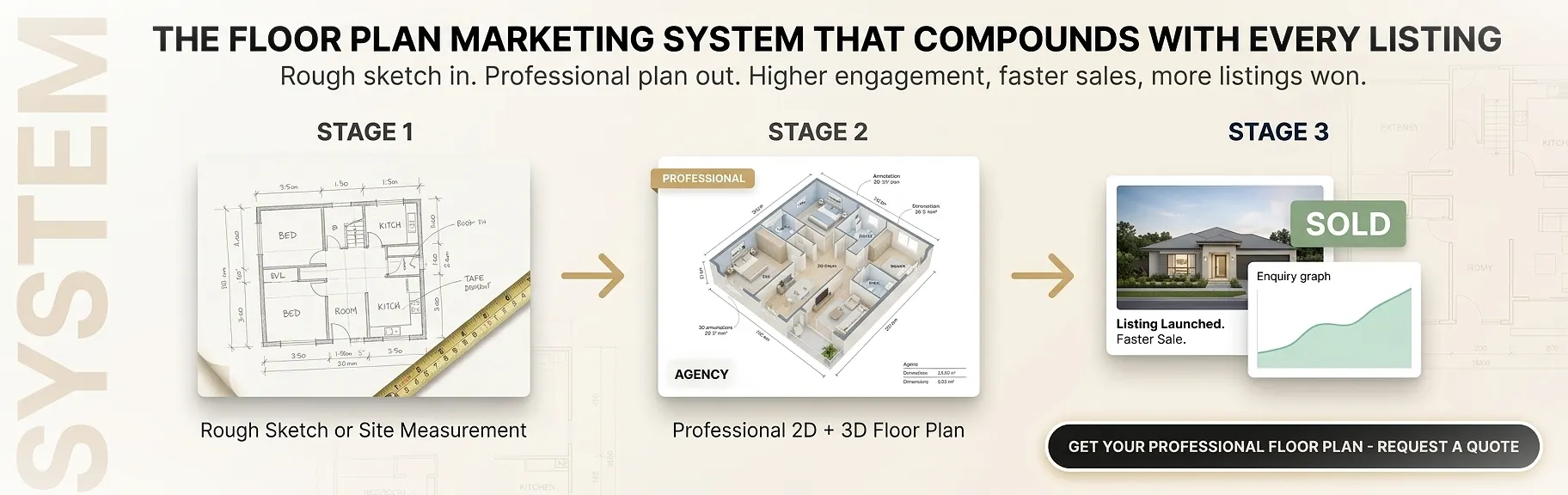
The agents who dominate their local markets in 2026 are not simply the best negotiators or the most experienced valuers. They are the agents who show up with better marketing materials, more professional listing presentations, and a documented system for turning property appraisals into compelling buyer experiences across every digital and physical channel.
The gap between agents who use professional floor plans consistently and those who do not is measurable in clicks, in enquiries, in days on market, and ultimately in the number of listings won and commissions earned per quarter.
The floor plan is not a cost. It is the highest-leverage marketing asset you will deploy on every single listing you take to market.
Ready to equip every listing in your portfolio with publication-quality 2D floor plans, 3D floor plans, and photorealistic exterior renderings? Work with our professional floor plan and visualization team to build your complete listing marketing package – and explore transparent pricing across all service tiers before you brief your next campaign.