
Everything you need to know about 3D floor plans – from how they work and who uses them, to real-world examples, costs, and how to get a stunning one for your next project.
Have you ever looked at a flat architectural drawing and struggled to picture how the finished space would actually look and feel? You are not alone. That precise problem is why 3D floor plans have become one of the most sought-after tools in real estate, architecture, and interior design.
What is a 3D Floor Plan?
A 3D floor plan is a three-dimensional, bird’s-eye-view visualization of a building’s interior layout. Unlike a flat 2D blueprint, a 3D floor plan shows rooms, walls, furniture, fixtures, flooring, and finishes with realistic depth, color, and texture – making it instantly understandable to everyone, not just trained architects or engineers.
In simple terms, a 3D floor plan takes the same information contained in a traditional 2D drawing – room sizes, wall positions, door and window locations – and presents it as a richly detailed, three-dimensional overhead view. Suddenly, a living room with a sectional sofa, a kitchen island, and an open dining area becomes vivid and real, not just a collection of lines and symbols.
Throughout this guide, we will explore everything you need to know: how 3D floor plans are created, who benefits from them, what they cost, and how you can get a professional-quality one for your own project. Whether you are a real estate agent marketing a new listing, an architect presenting a design to a client, a developer launching a residential project, or simply a homeowner planning a renovation – this guide is for you.
How Do 3D Floor Plans Work?
Understanding how a 3D floor plan is produced helps you appreciate its value and communicate clearly with the design team creating yours. At its core, a 3D floor plan is a marriage of architectural accuracy and artistic rendering.
The Step-by-Step 3D Floor Plan Creation Process
- Input Collection – The Raw Material The process begins with gathering your source documents: architectural drawings, sketches, photographs, measurements, or even a rough hand-drawn sketch. Many clients also supply a floor plan sketch or an existing 2D drawing that serves as the base reference.
- 2D Base Drawing – The Structural Foundation A professional drafter creates or refines a precise 2D base plan using software such as AutoCAD. This drawing captures all walls, doors, windows, staircases, and room boundaries with accurate dimensions. If you already have a 2D floor plan, this step may be skipped or shortened considerably.
- 3D Modeling – Bringing Depth to the Drawing The 2D base is then imported into a 3D modeling environment – typically 3ds Max, SketchUp, Revit, or a specialized rendering platform. Walls are extruded to height, ceilings added, and the entire structure gains three-dimensional form.
- Furniture and Fixture Placement Designers populate the model with furniture, appliances, sanitary fixtures, and decorative elements appropriate to each room. This step is where the plan truly comes to life, letting viewers instantly understand how the space will be used and how traffic will flow through it.
- Materials, Textures, and Finishes Flooring materials, wall colors, tile patterns, countertop finishes, and other surface details are applied. Clients often provide style preferences or mood boards at this stage to ensure the final output matches their vision.
- Lighting Setup Lighting – both natural (windows, skylights) and artificial (ceiling lights, lamps) – is configured. Good lighting dramatically increases the realism and visual appeal of the finished 3D floor plan.
- Rendering and Final Output The fully detailed 3D model is rendered – processed through a rendering engine such as V-Ray or Corona – to produce a photorealistic still image (or animated walkthrough). The result is delivered as a high-resolution file ready for presentations, listings, brochures, or websites.
Pro Tip
You do not need a perfectly drafted architectural drawing to get started. Professional services like converting an image to a floor plan allow teams to work from photographs, scanned sketches, or even rough hand-drawn notes.
2D vs 3D Floor Plans: Key Differences Explained
To fully appreciate what a 3D floor plan offers, it helps to understand how it compares to its traditional counterpart. Many projects use both formats together – the 2D for technical documentation and the 3D for client communication and marketing.
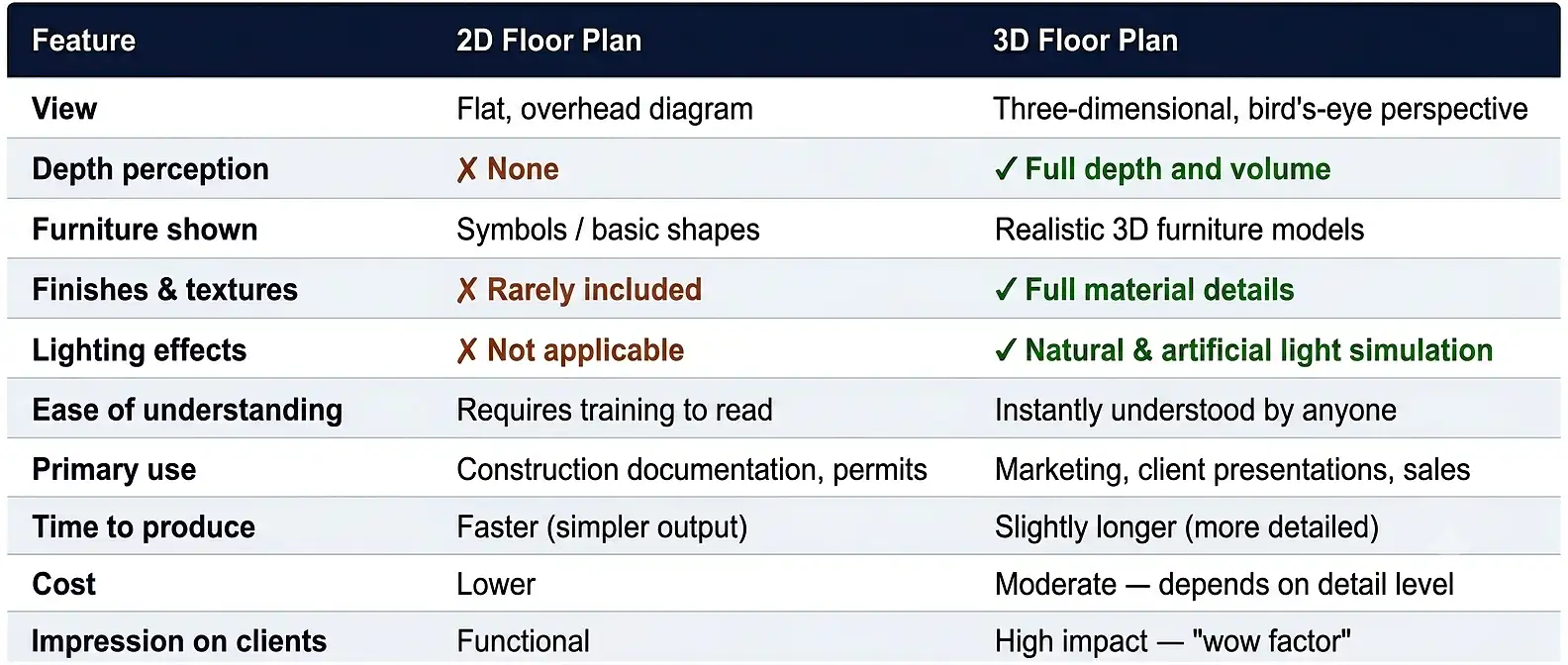
For a deeper dive into this comparison, read our full guide on the difference between 2D floor plans and 3D floor plans. It is worth noting that these two formats are complementary, not competing – the best projects use both strategically.
🔎 Did You Know?
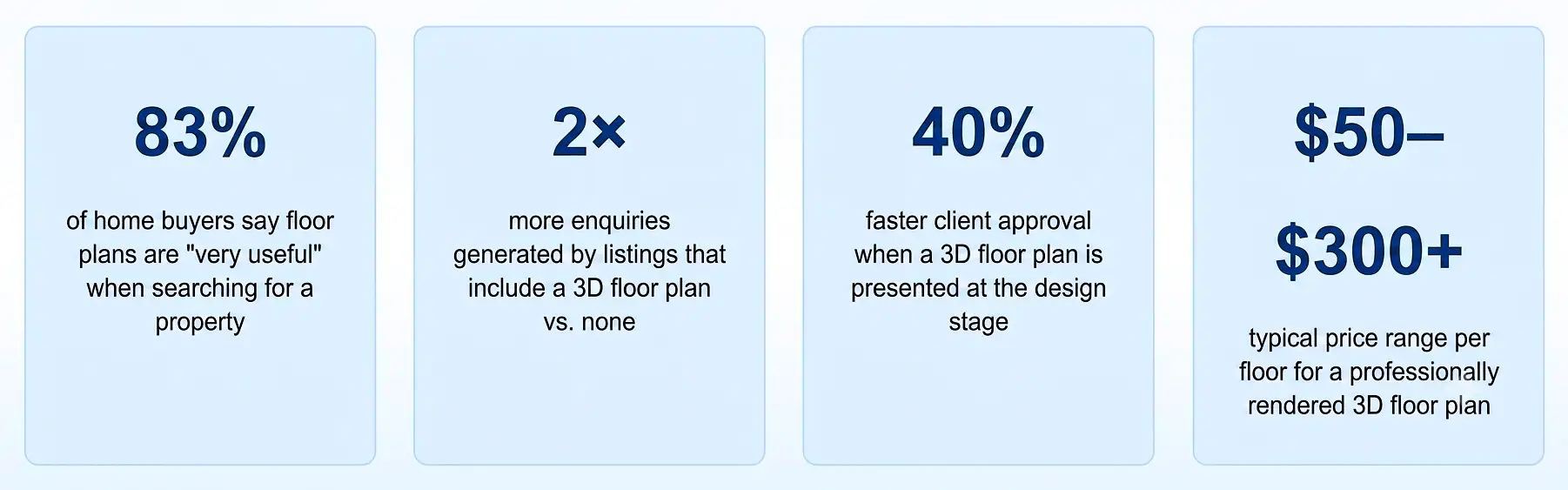
According to research by the National Association of Realtors (NAR), over 95% of buyers use digital tools to search for homes – and visual content is consistently rated as the most important feature of any listing. A 3D floor plan is one of the highest-converting visual assets you can include.
Types of 3D Floor Plans: Which One Do You Need?
Not all 3D floor plans are created equal. Depending on your budget, audience, and intended use, you can choose from several distinct styles and quality levels. Understanding these options upfront will help you make the smartest investment.
1. Standard 3D Floor Plan
The most popular option for real estate listings and residential projects. A standard 3D floor plan presents a clean, overhead perspective with simplified furniture models, basic textures, and clear room labeling. It strikes a strong balance between visual impact, quick turnaround, and affordable cost.
2. Photorealistic 3D Floor Plan (Premium Rendering)
For luxury developments, high-end marketing campaigns, and architectural portfolios, a photorealistic 3D floor plan delivers unmatched visual quality. High-resolution textures, dramatic lighting, lifelike furniture, and carefully styled décor create images that could easily be mistaken for interior photographs.
3. Furnished vs. Unfurnished 3D Floor Plan
Some clients prefer an unfurnished 3D floor plan that focuses purely on the architectural space – useful for new construction or commercial projects where the eventual layout is unknown. A furnished 3D floor plan, by contrast, shows a suggested (or confirmed) furniture arrangement, making it ideal for residential sales and interior design presentations.
4. Colored vs. Monochrome 3D Floor Plan
Full-color 3D floor plans are the industry standard for marketing. However, stylized monochrome or grayscale versions are occasionally used for editorial, branding, or minimalist presentations.
5. Multi-Level (3D) Floor Plan
Multi-story buildings – townhouses, apartments, or commercial buildings – benefit from multi-level 3D floor plans that show each floor side by side or stacked, giving viewers a complete picture of the entire building.
6. Aerial / Site 3D Rendering
Sometimes a project requires zooming out from the individual floor to show the broader site context – how a building sits on a plot, how multiple units relate to one another, or how landscaping integrates with the structure.
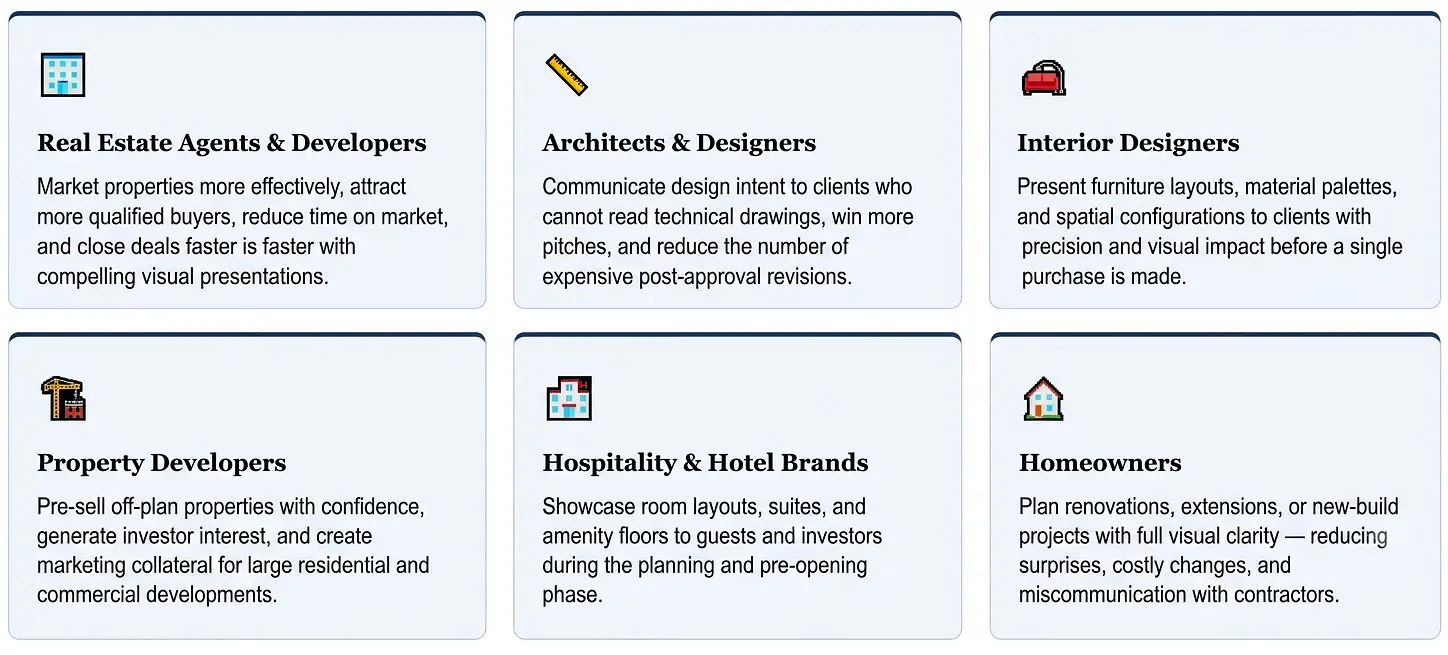
Who Uses 3D Floor Plans? Real-World Applications
The versatility of 3D floor plans makes them valuable across an impressive range of industries and roles. Here is a look at the primary user groups and how each benefits from this powerful visual tool.
Key Benefits of 3D Floor Plans
The growing popularity of 3D floor plans is no accident. They deliver measurable, tangible benefits to everyone involved in a property transaction or construction project. Here are the most compelling reasons to invest in one.
1. Universal Clarity – Anyone Can Understand Them
Traditional 2D blueprints are designed for professionals. A 3D floor plan speaks to everyone – buyers, tenants, investors, family members, and contractors – without requiring any architectural training. This universal legibility dramatically reduces misunderstandings and streamlines decision-making.
2. Stronger First Impressions in Marketing
In a competitive property market, first impressions determine who clicks, who enquires, and who ultimately buys. A professionally rendered 3D floor plan transforms a listing from ordinary to extraordinary. According to Zillow Research, listings with rich visual content including floor plans generate significantly higher engagement than those without.
3. Reduced Design Revisions and Costly Changes
One of the most financially significant benefits of a 3D floor plan occurs at the design stage. When clients can see exactly how a space will look and function, they identify issues – a cramped bathroom, a poorly positioned kitchen island, insufficient bedroom storage – before construction begins. Catching these problems early is dramatically cheaper than correcting them on-site.
4. Powerful Pre-Sale and Off-Plan Marketing Tool
For developers marketing properties before completion, a 3D floor plan creates a complete visual package that allows buyers to confidently commit to a purchase without seeing a finished property.
5. Better Space Planning and Furniture Arrangement
Whether you are designing a new home or reconfiguring an existing one, a 3D floor plan helps you experiment with different furniture layouts, traffic flow patterns, and spatial configurations – all before you invest in a single piece of furniture or lift a hammer.
6. Competitive Differentiation
Many agents, architects, and developers still rely solely on flat drawings and static photographs. Offering a high-quality 3D floor plan immediately positions you as a modern, client-focused professional – a meaningful competitive advantage.
7. Versatility Across Multiple Channels
A single 3D floor plan image can be used across listing portals, brochures, social media, websites, investor decks, and printed marketing materials – making it an exceptionally versatile investment that delivers value across multiple touchpoints.
Summary: Top 7 Benefits at a Glance
- Universal clarity – no architectural knowledge required
- Higher listing engagement and more buyer enquiries
- Fewer expensive late-stage design changes
- Powerful off-plan and pre-sale marketing tool
- Better space planning before construction or purchase
- Competitive differentiation in a crowded market
- Multi-channel versatility – one asset, many uses
How to Create a 3D Floor Plan: Your Options
You have three main routes when it comes to creating a 3D floor plan. Each has its own trade-offs in terms of cost, time, quality, and technical expertise required.
Option 1: Use DIY 3D Floor Plan Software
Several software tools allow non-professionals to create basic 3D floor plans without formal architectural training. Popular options include RoomSketcher, Planner 5D, and SmartDraw. While these tools are accessible and affordable for very simple projects, they typically produce generic-looking results and lack the photorealistic quality required for professional marketing.
Option 2: Hire a Freelance 3D Designer
Engaging an individual freelance designer through platforms like Upwork or Fiverr can produce good results, but quality varies significantly. Additionally, freelancers often lack the project management infrastructure, revision processes, and turnaround speed that professional studios provide.
Option 3: Work with a Professional 3D Floor Plan Studio (Recommended)
For professional-grade results – the kind that genuinely impress clients and drive sales – working with a specialist studio is the smartest choice. A dedicated team brings consistent quality standards, fast delivery, experienced designers, and a structured revision process.
At The 2D3D Floor Plan Company, we specialize exclusively in professional 3D floor plan creation. Our team can work from virtually any input – a sketch, photograph, existing 2D drawing, or architectural plan – to deliver a beautifully rendered 3D floor plan, typically within 24–48 hours.
If you already have a 2D drawing, we also offer a specialized 2D to 3D floor plan conversion service that is fast, affordable, and requires minimal effort on your part.
Converting an Existing 2D Plan to 3D
One of the most common requests we receive is from clients who already have a flat 2D drawing and want to transform it into a vivid 3D floor plan. This process is known as converting a floor plan to 3D, and it is both faster and more affordable than many people expect.
How Much Does a 3D Floor Plan Cost?
Cost is naturally one of the first questions clients ask. The good news is that professional 3D floor plans are far more affordable than most people assume – particularly given the marketing and sales value they deliver in return.
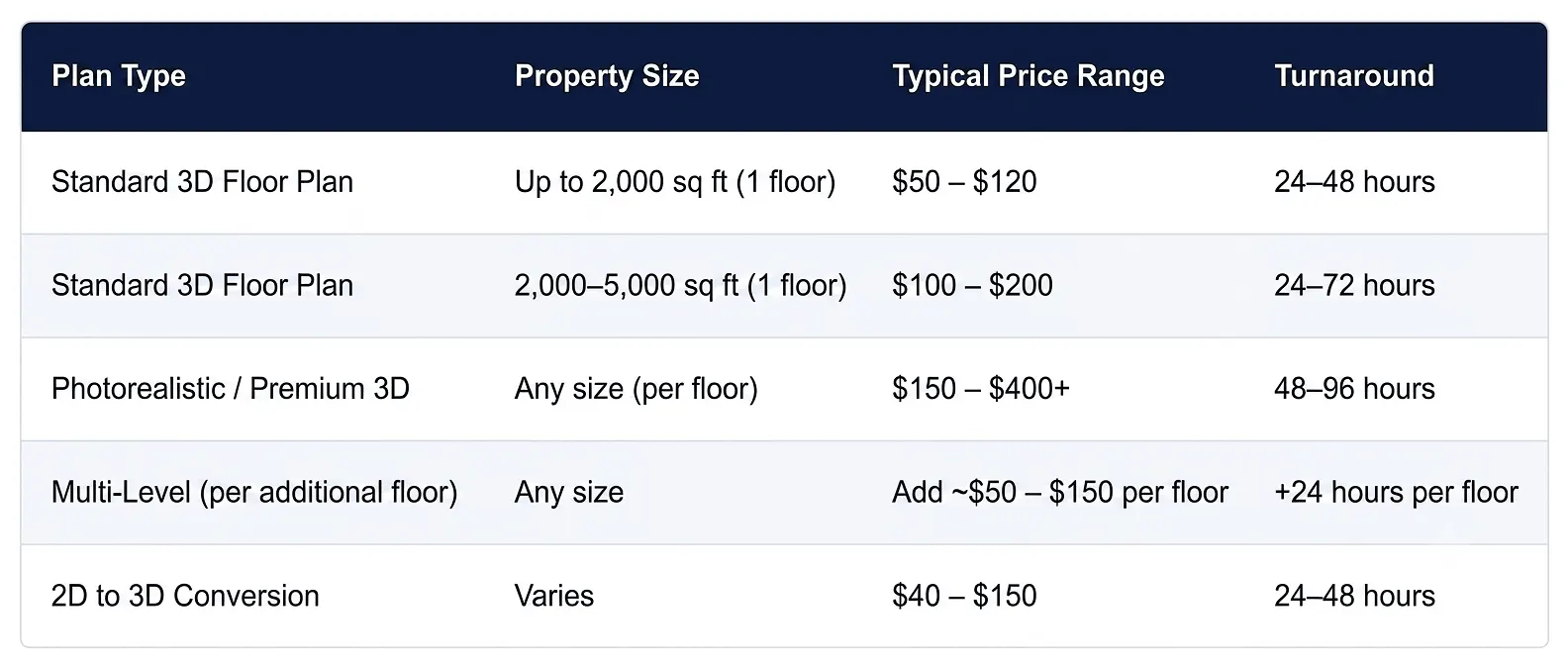
For exact pricing tailored to your project, visit our 3D floor plan pricing page or browse our 3D floor plan packages to find the right option. We also offer combined packages through our full pricing overview.
For a broader understanding of rendering costs, our detailed guide on how much a 3D rendering of a house costs provides a comprehensive market overview.
Value Perspective
Consider this: a professional 3D floor plan costing $80–$150 could generate multiple additional property enquiries, shorten your listing’s time on market by weeks, and contribute to a higher sale price. The return on investment is often measured in thousands of dollars, not tens.
Common Mistakes to Avoid When Using 3D Floor Plans
Even though 3D floor plans are powerful tools, some clients and professionals undermine their effectiveness through avoidable errors. Here are the most common pitfalls – and how to sidestep them.
Mistake #1: Providing Inaccurate or Incomplete Input
The most impactful thing you can do to ensure a high-quality 3D floor plan is to provide clear, complete, and accurate source materials. Ambiguous drawings, missing room dimensions, or unspecified furniture preferences all lead to revisions, delays, and frustration. Take the time to prepare a clear brief before you submit your project.
Mistake #2: Choosing the Wrong Detail Level for the Budget
Clients sometimes request photorealistic premium rendering quality while budgeting for a standard plan – or conversely, over-invest in premium rendering for a property type where a standard plan would be equally effective. Discuss your goals and audience with your design team to choose the appropriate quality tier.
Mistake #3: Ignoring Scale and Proportion
Furniture and fixtures must be accurately scaled to the floor plan. An oversized sofa or an unrealistically small kitchen table misleads buyers and undermines trust. Professional designers always use real-world scale references when populating 3D models.
Mistake #4: Neglecting Room Labels and Dimensions
A beautiful 3D floor plan that omits room names, key dimensions, or a north-arrow orientation is significantly less useful to buyers and decision-makers. Always request clearly labeled plans that include at least room names and primary dimensions. See how dimensions are handled in our 2D floor plan with dimensions guide for best practices.
Mistake #5: Using a 3D Floor Plan in Isolation
A 3D floor plan is most effective as part of a broader visual marketing package. Pairing it with high-quality photography, a 3D exterior rendering, and interior renderings creates a cohesive, professional presentation that significantly outperforms any single element on its own.
Mistake #6: Not Leveraging It Across All Marketing Channels
Some clients create a beautiful 3D floor plan and then use it only on one listing portal. In reality, the same image can be repurposed across your website, email campaigns, social media, printed brochures, and investor presentations – multiplying the return on your investment without any additional cost.
Expert Tips for Getting the Best 3D Floor Plan
After producing thousands of 3D floor plans for clients across real estate, architecture, hospitality, and property development, our team has gathered a set of expert insights that consistently lead to better outcomes.
Tip 1: Always Include a Clearly Dimensioned 2D Drawing
Even if your ultimate goal is a stunning 3D floor plan, providing an accurate 2D floor plan as the base reference dramatically improves accuracy and reduces revision rounds. If you only have sketches or photographs, our team can generate the 2D base for you as part of the process.
Tip 2: Define Your Audience Before Choosing a Style
The right 3D floor plan style depends entirely on who will view it. Luxury buyers respond to richly detailed photorealistic renders with premium finishes. A commercial tenant reviewing a lease option may prefer a clean, simply furnished plan with clear dimensions. Always design for your specific viewer.
Tip 3: Specify Your Preferred Color Palette and Furniture Style
The more guidance you provide on aesthetic preferences – contemporary, traditional, Scandinavian, industrial – the more closely the final result will align with your vision. Supply reference images or a mood board if possible.
Request your 3D floor plan in multiple file formats and resolutions at the time of delivery. A high-resolution version for print, a web-optimized version for digital use, and a version with and without room labels ensures maximum versatility across all your marketing channels.
Tip 5: Combine 3D Floor Plans With Exterior Renderings for Maximum Impact
For new construction and off-plan properties, the combination of a 3D floor plan and a photorealistic 3D house front design or exterior rendering creates a complete visual package. Buyers can envision both the outside and the inside of a property they have never physically visited – a powerful sales tool that builds confidence and commitment.
Tip 6: Request Samples Before Committing
Always review a studio’s portfolio before placing an order. At The 2D3D Floor Plan Company, we maintain an extensive 3D floor plan samples gallery so you can assess our quality and style firsthand before starting your project.
What to Look for in a 3D Floor Plan Service Provider
Choosing the right studio is as important as deciding to invest in a 3D floor plan in the first place. The following comparison highlights the key attributes that distinguish exceptional providers from average ones.
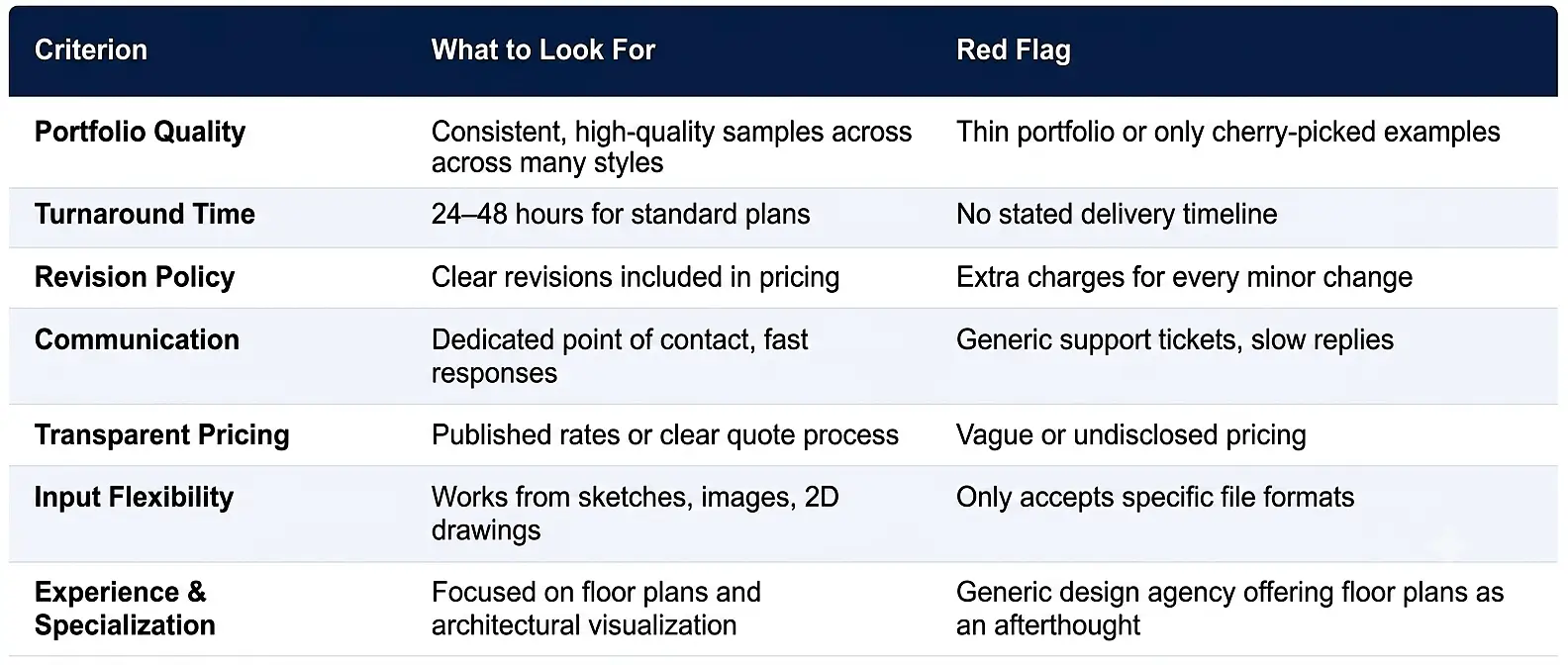
As a dedicated floor plan and architectural visualization studio, The 2D3D Floor Plan Company meets all of these criteria.
Beyond 3D Floor Plans: Our Complete Visualization Services
A 3D floor plan is often the starting point of a broader visual strategy. Depending on your project, you may benefit from complementary services that create a complete, professional visualization package.
- 3D Exterior Rendering – Show the outside of your building with photorealistic accuracy before it is built.
- 3D Interior Rendering – Bring individual rooms to life with detailed, photorealistic interior visualizations.
- 2D Floor Plan Drawing – Clean, dimensioned 2D plans for permits, construction, and documentation.
- 2D & 3D Site Plan Rendering – Overhead visualizations showing how buildings sit within their wider site context.
- 2D to 3D Floor Plan Conversion – Transform any existing 2D drawing into a stunning 3D floor plan.
Explore all of our services and packages on the pricing page or learn more about our team and studio.
Frequently Asked Questions About 3D Floor Plans
What is a 3D floor plan, exactly?
A 3D floor plan is a three-dimensional, bird’s-eye visualization of a building’s interior layout. It shows rooms, furniture, walls, finishes, and fixtures with realistic depth, color, and texture – making it far easier to understand than a traditional flat 2D blueprint. It is one of the most effective visual tools in real estate marketing and architectural design.
What is the difference between a 2D and a 3D floor plan?
A 2D floor plan is a flat, overhead diagram that shows room dimensions and layout using lines and architectural symbols. A 3D floor plan adds depth, realistic furniture, textures, finishes, and lighting to create a vivid, lifelike view of the same space. Both serve important but different purposes. For a detailed comparison, see our guide on the difference between 2D and 3D floor plans.
How much does a 3D floor plan cost?
The cost of a professional 3D floor plan typically ranges from around $50 for a small standard plan to $400+ for premium photorealistic rendering of a large property. The exact price depends on the size of the property, the level of detail and realism required, and the turnaround time needed. Visit our 3D floor plan pricing page for detailed, transparent rates.
What information do I need to provide to get a 3D floor plan?
At a minimum, you need an existing 2D drawing, architectural plan, sketch, or even a rough hand-drawn layout with room dimensions. The more information you provide – including furniture preferences, material choices, and style references – the closer the final result will match your vision. Our team can work from almost any starting point.
Can I convert my existing 2D floor plan into a 3D floor plan?
Absolutely. Converting a 2D floor plan to a 3D floor plan is one of our most popular services. You simply send us your existing 2D drawing, and our team handles the entire 3D modeling and rendering process.
How long does it take to get a 3D floor plan?
Standard 3D floor plans are typically delivered within 24–48 hours of receiving complete project materials. More complex or larger projects, and premium photorealistic renderings, may take 48–96 hours. Rush delivery options are also available for time-sensitive projects.
What software is used to create 3D floor plans?
Professional studios typically use a combination of AutoCAD (for precise 2D base drawings), 3ds Max or SketchUp (for 3D modeling), and rendering engines such as V-Ray or Corona Renderer for photorealistic output. According to Autodesk, these tools represent the industry standard for architectural visualization globally.
Are 3D floor plans useful for small properties or apartments?
Yes, absolutely. In fact, 3D floor plans are particularly valuable for small spaces because they help viewers understand how a compact area is organized and what it feels like to live in – something that is much harder to convey with photographs alone. Apartments, studio flats, and small homes benefit enormously from a well-designed 3D floor plan.
Why a 3D Floor Plan is an Investment Worth Making
So, what is a 3D floor plan? It is, quite simply, one of the most powerful communication tools available in architecture, real estate, and property development today. By transforming flat, technical drawings into vivid, three-dimensional visualizations that anyone can immediately understand, 3D floor plans eliminate confusion, accelerate decision-making, and drive measurably better outcomes – whether that means more buyer enquiries, faster sales, fewer construction errors, or more successful client presentations.
Throughout this guide, we have explored what a 3D floor plan is and how it is created, the key differences between 2D and 3D plans, the various types available, the wide range of professionals and individuals who benefit from them, the specific advantages they deliver, the costs involved, common mistakes to avoid, and expert tips to ensure you get the very best results.
The bottom line is this: in a world where visual communication increasingly determines who wins and who loses in competitive markets, a professionally rendered 3D floor plan is not a luxury – it is a strategic advantage. The return on investment, measured in enquiries generated, deals closed, and revisions avoided, far outweighs the modest cost involved.
Whether you are a real estate agent with a listing to sell, a developer with a project to pre-sell, an architect with a concept to present, or a homeowner with a renovation to plan – a 3D floor plan will make your vision clearer, your communication stronger, and your outcomes better.
Start Your 3D Floor Plan Project Today
Fast turnaround. Professional quality. Transparent pricing. Our team is ready to transform your drawings into stunning 3D floor plans — often within 24 hours.
3D Floor Plan Rendering Services