
If you have ever scrolled past a listing because you could not picture how the rooms connected, you already understand the problem this article solves. A 2D floor plan for real estate listings gives buyers the one thing photos and videos cannot: a clear, top-down sense of layout, flow, and proportion. Research consistently shows that listings with a floor plan attract more clicks, longer view times, and ultimately more inquiries – with some studies pointing to conversion lifts as high as 52% when a floor plan is added to the listing package.
In this guide, we will break down exactly why floor plans move the needle, how they compare with 3D alternatives, what mistakes agents commonly make, and how you can add a polished 2D floor plan for real estate listings to your next property package without slowing down your marketing timeline.
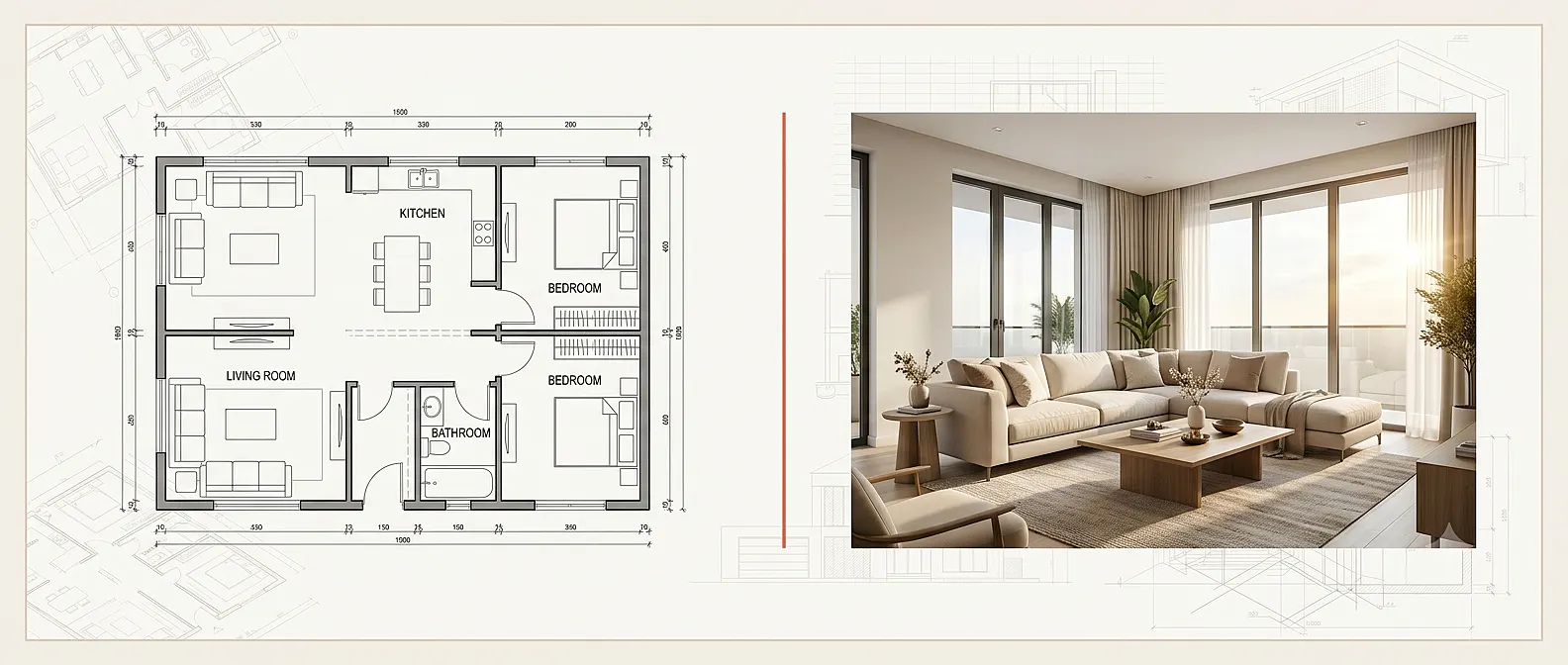
What is a 2D Floor Plan for Real Estate Listings?
A 2D floor plan for real estate listings is a scaled, top-down drawing of a property that shows room dimensions, wall placements, doors, windows, and the overall flow between spaces. Unlike a photo or a walkthrough video, it gives buyers an instant, accurate sense of how the home is organized – something that is notoriously hard to grasp from a series of disconnected room photos.
In short, a 2D floor plan answers the question every buyer asks within the first few seconds of opening a listing: “How does this place actually flow, and will my furniture fit?”
Key Elements of an Effective Floor Plan
- Accurate room dimensions and total square footage
- Clearly labeled rooms, closets, and storage areas
- Door swings, windows, and circulation paths
- Standardized symbols for fixtures (refer to our floor plan symbols and legend guide for a full reference)
- Branding elements such as agency logo and listing details
Why a 2D Floor Plan for Real Estate Listings Boosts Conversions
Floor plans do not just look professional – they directly influence buyer behavior at every stage of the funnel. Here is what happens when a floor plan is added to a listing:
1. Buyers Spend More Time on the Listing
When a buyer can see the layout at a glance, they linger longer on the page, scrolling between the floor plan and the photos to mentally map the home. Consequently, average time-on-listing increases, which signals relevance to portals like Zillow and Realtor.com and can improve organic placement within those platforms.
2. Fewer Wasted Viewings
Because a floor plan sets accurate expectations about size and layout before a buyer books a tour, agents report fewer no-shows and fewer “this is not what I expected” reactions on-site. As a result, the viewings that do happen tend to be with more qualified, more serious buyers.
3. Higher Perceived Value and Trust
A clean, branded 2D floor plan for real estate listings signals professionalism. It tells the buyer that the agent has nothing to hide about layout or proportions – which builds the kind of trust Google’s E-E-A-T guidance increasingly rewards for property-related content, since transparency and first-hand accuracy are core trust signals.
4. Better Performance on Mobile
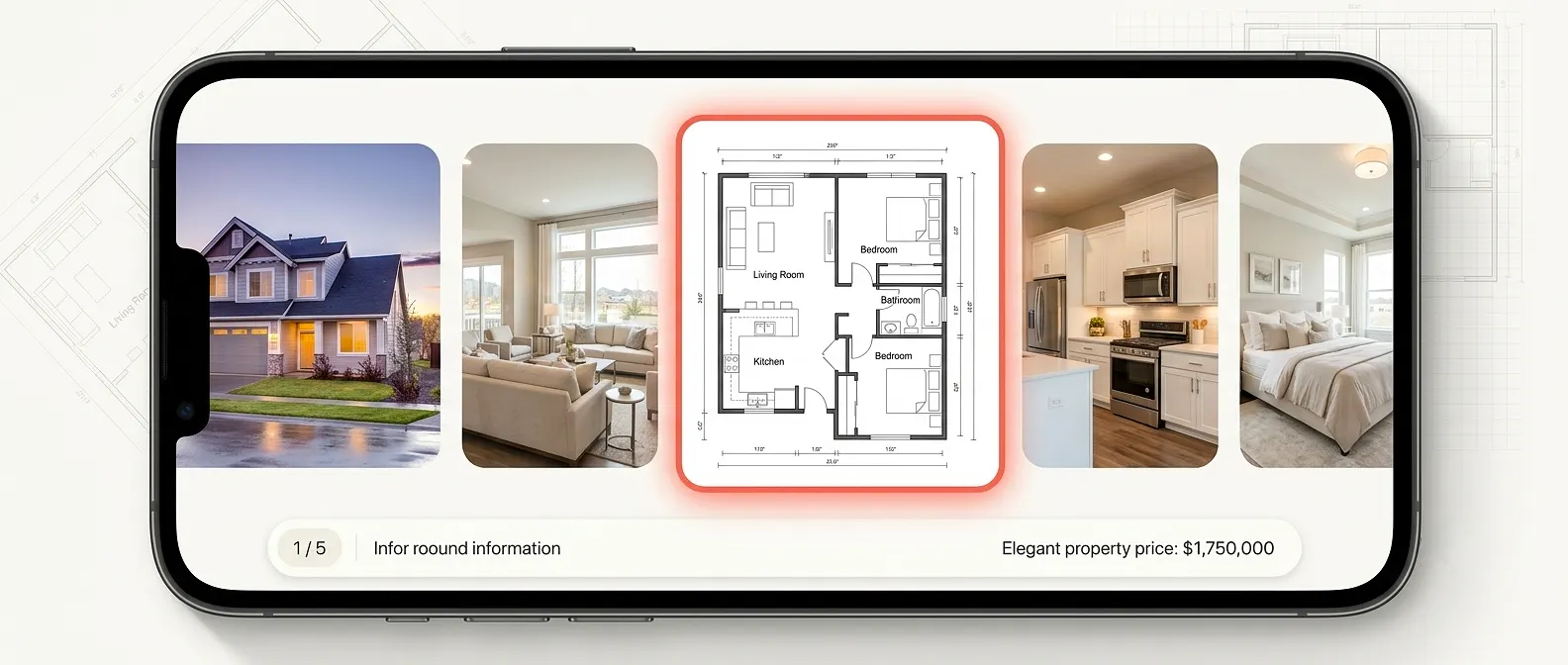
Most buyers browse listings on their phones, where photo galleries can feel fragmented. A floor plan acts as a single visual anchor that ties the whole gallery together, and because Google uses mobile-first indexing, listing pages that load a lightweight, well-labeled floor plan image tend to perform better in mobile search results too.
The Data Behind the 52% Conversion Lift
Multiple industry studies point in the same direction: adding a floor plan to a listing materially improves engagement metrics. The table below summarizes the typical impact reported across recent property-portal research.
| Listing Metric | Typical Improvement With a 2D Floor Plan |
|---|---|
| Overall listing inquiries / conversions | Up to 52% higher |
| Average time spent on listing | Significantly longer |
| Listing page views / clicks | Noticeably higher |
| Buyer-reported confidence before viewing | Markedly improved |
| Wasted in-person viewings | Reduced |
While exact percentages vary by market and property type, the direction of the data is consistent: a 2D floor plan for real estate listings is one of the highest-leverage, lowest-cost additions an agent can make to a listing package.
2D Floor Plans vs 3D Floor Plans for Listings: Which Should You Use?
Both formats add value, but they serve slightly different purposes. If you are weighing the two, our detailed breakdown of the differences between 2D and 3D floor plans goes deeper, but here is a quick comparison for listing purposes:
| Factor | 2D Floor Plan | 3D Floor Plan |
|---|---|---|
| Best for | Quick layout comprehension, MLS uploads | Visualizing finishes, furniture, and depth |
| Turnaround time | Fastest | Slightly longer |
| Typical cost | Lower | Moderate to higher |
| Ideal placement | MLS, listing page, brochures | Hero image, social media, premium listings |
| Buyer takeaway | “How does this flow?” | “What will this feel like?” |
Many agents combine both: a 2D floor plan for real estate listings for fast comprehension, plus a 3D floor plan for emotional impact. If you already have a 2D plan and want to upgrade it, see how to convert a floor plan to 3D without redrawing from scratch.
How to Add a 2D Floor Plan to Your Real Estate Listing: Step-by-Step
Adding a professional floor plan to your listing package is straightforward once you know the workflow. Follow these steps:
- Gather source material. Use existing architectural drawings, a hand sketch, or rough on-site measurements. If all you have is a photo or a rough sketch, services that convert a sketch into a polished plan can save hours.
- Choose the right scale and orientation. Standard scales (such as 1:100) make it easy for buyers to compare room sizes at a glance.
- Label every room and dimension. Include square footage per room and the total area, since buyers actively search for this detail.
- Apply consistent symbols. Use standardized door, window, and fixture symbols so the plan reads correctly to anyone, including agents reviewing it for the MLS.
- Add branding. Insert your agency logo, listing address, and contact details directly on the plan image.
- Export at listing-ready resolution. A crisp, high-resolution JPG or PNG ensures the plan looks sharp on both desktop and mobile.
- Upload to every channel. Add the floor plan to the MLS, your listing page, PDF brochures, and social posts – not just one location.
If you would rather not draw from scratch, our 2D floor plan service handles steps 1 through 6 for you, and our sample 2D floor plan gallery shows the level of detail and labeling buyers respond to best.
Our Step-by-Step Design Process
An accurate architectural workflow for premium real estate listings
Common Mistakes Agents Make With Listing Floor Plans
Even well-intentioned floor plans can fall flat if a few common pitfalls are not avoided:
- Skipping dimensions entirely – buyers want exact square footage, not just a shape.
- Using inconsistent or unclear symbols, which can confuse rather than clarify (see the standard symbol reference for guidance).
- Uploading a low-resolution image that becomes blurry on mobile screens.
- Placing the floor plan as the very last image, after buyers have already lost interest.
- Forgetting to match the floor plan’s orientation with the property photos, which can disorient viewers.
- Leaving out branding, missing a simple opportunity for repeat-business recall.
Expert Tips to Maximize Listing Conversions With Floor Plans
- Place the floor plan within the first 3-5 images of the gallery, right after the hero exterior or living room shot.
- Pair the 2D plan with a 3D exterior rendering for new builds or off-plan properties, so buyers see both layout and exterior look.
- For larger properties, consider a 3D floor plan with high-quality rendering as a hero image, then use the 2D version for technical clarity.
- If the property has multiple units, such as an apartment building, link to a broader apartment complex map so buyers understand the unit’s position within the whole.
- When measurements matter most – for example, in compact urban units – always provide a 2D floor plan with dimensions rather than a plain outline.
- Choose efficient drafting tools; our roundup of the best 2D floor plan software can help in-house teams speed up production.
Floor Plans for Special Property Types
Certain property categories benefit even more from a clear 2D floor plan for real estate listings, simply because their layouts are harder to grasp from photos alone:
- Hotels and hospitality properties, where hotel floor plans help investors evaluate guest flow and amenity placement.
- Penthouses and luxury units, where penthouse floor plans highlight terraces, multiple wings, and premium layouts.
- New construction, where comparing a site plan versus a floor plan helps buyers understand both the lot and the home itself.
- Family homes, where browsing 3-bedroom 3D floor plan examples alongside the 2D version gives a fuller picture for larger households.
FAQ: 2D Floor Plans for Real Estate Listings
Does a 2D floor plan really increase listing conversions?
Yes. Industry data shows that listings with a 2D floor plan for real estate listings can see conversion increases of up to 52%, driven by longer view times, more inquiries, and better-qualified viewings.
Where should a floor plan be placed in a listing gallery?
Ideally within the first 3-5 photos, right after the main exterior or living area shot, so buyers see it before they lose interest.
Do I need both a 2D and 3D floor plan?
Not always, but combining a 2D floor plan for technical clarity with a 3D floor plan for visual impact often produces the strongest results, especially for premium listings.
What information must be on the floor plan?
Room labels, dimensions, total square footage, door and window placements, and consistent symbols are essential for buyer comprehension.
How long does it take to get a listing-ready floor plan?
Turnaround varies by complexity, but most standard 2D floor plans for listings can be completed within a short production cycle, often a day or two.
A 2D Floor Plan for Real Estate Listings is a High-ROI Investment
Across nearly every metric that matters – inquiries, time-on-listing, viewing quality, and buyer trust – a 2D floor plan for real estate listings consistently outperforms listings without one. Given the relatively modest cost and fast turnaround compared with the conversion gains involved, it is one of the easiest upgrades an agent or developer can make to a marketing package.
Ready to see the difference for yourself? Explore our 2D floor plan service, browse our pricing options, or get in touch for a free sample plan tailored to your next listing.